Map Your Attack Surface Structured Architecture Docs
Map every component, trust boundary, and input surface, then generate clear architecture.md and coverage-ledger.json for full visibility.
cloudflare/security-audit-skill
A coding-agent skill for multi-phase security audits with independently verified, machine-readable findings
THE USEFUL PART
A coding-agent skill for multi-phase security audits with independently verified, machine-readable findings
THE STACKRADAR WALKTHROUGH
A short introduction from our reel. See the project README for the current details.
Map every component, trust boundary, and input surface, then generate clear architecture.md and coverage-ledger.json for full visibility.
Deploy isolated hunter agents to each ledger unit, automatically record checks and spotlight coverage gaps you might otherwise miss.
Run fresh verifier agents on every candidate, producing independent, source‐traceable records so you trust each confirmed finding.
GITHUB SNAPSHOT
Recorded counts, not a growth rate or a quality score.
OBSERVED STAR HISTORY
Daily source snapshots are collected automatically. A trend appears after at least two real observations—no invented historical growth.

FROM THE PROJECT
Source excerpts from the project's README. Not an independent review, verification or security audit.
A coding-agent skill that turns your agent into a security auditor. It orchestrates isolated agents through reconnaissance, coverage-led hunting, candidate validation, structured output, independent record verification, and target-neutral reporting.
This is the skill that seeded Cloudflare's vulnerability discovery harness, described in Build your own vulnerability harness. The harness grew into a multi-stage, fleet-wide system; this skill is the single-repo starting point it evolved from.
The skill runs a structured audit in six phases:
Reconnaissance -- map architecture, trust boundaries, input surfaces, prior evidence, and deterministic coverage in architecture.md and coverage-ledger.json.
Coverage-led hunting -- assign isolated hunters from ledger units, record their checks, and use coverage critics to find gaps.
Candidate validation -- give every unique candidate to a fresh verifier that tries to disprove it.
Structured output -- write confirmed, needs_validation, and rejected records to findings.json and validate them against report-schema.json.
Independent record verification -- fresh agents verify final source claims. Material replacements receive another independent verifier.
Target-neutral reporting -- derive REPORT.md, FINDINGS-DETAIL.md, and NEEDS-VALIDATION.md from the verified records and coverage ledger.
The parent runs validate-coverage-ledger.cjs after creating the ledger and after each later ledger update. It runs validate-findings.cjs in Phase 4 and again after every Phase 5 replacement.
The verdicts are distinct: confirmed has a complete source trace and bounded observed result, needs_validation has an exact unresolved fact and no severity, and rejected records a disproved candidate.
Multiple runs against the same repo are additive. The skill uses prior ledgers and findings to target gaps, revalidate changed source, and carry forward current-source evidence without treating stale or unresolved work as covered.
| File | Purpose |
|---|---|
| SKILL.md | Setup, core principles, platform terminology, workflow overview, and audit anti-patterns |
| RECONNAISSANCE.md | Phase 1 reconnaissance prompts and synthesis instructions |
| HUNTING.md | Phase 2 orchestration, hunting methodology, and validation rules |
| ATTACK-CLASSES.md | Core, wildcard, and obvious-things attack prompts |
| MEMORY-SAFETY-AND-BINARY.md | Memory-safety, binary, and kernel hunting classes for native targets |
| AI-AND-LLM.md | Prompt-injection, agent/tool, and output-handling hunting classes for LLM-backed targets |
| WEB-PROTOCOL-AND-AUTH.md | HTTP request-framing, cache, and authentication-protocol hunting classes for HTTP-protocol and auth targets |
| CLIENT-SIDE.md | DOM-injection, messaging-trust, UI-redress, and prototype-pollution hunting classes for client-side/browser targets |
| SUPPLY-CHAIN-AND-RELEASE.md | Dependency, CI, release, signing, update, plugin, and extension hunting classes |
| CLOUD-AND-DEPLOYMENT.md | IAM, infrastructure-as-code, container, serverless, ingress, and runtime-configuration hunting classes |
| PROTOCOLS-RPC-AND-MESSAGING.md | RPC, serialization, queue, broker, webhook, and streaming-protocol hunting classes |
| RESOURCE-EXHAUSTION-AND-AVAILABILITY.md | Shared resource, quota, queue, worker, and operator-spend hunting classes |
| DATA-ISOLATION-AND-LIFECYCLE.md | Tenant isolation, cache, search, export, backup, migration, deletion, and restore hunting classes |
| DESKTOP-MOBILE-AND-LOCAL-IPC.md | Native app, deep-link, webview, exported-component, helper, daemon, and local-IPC hunting classes |
| VALIDATION-AND-REPORTING.md | Phases 3–6 candidate validation, structured output, record verification, and reporting |
| report-schema.json | JSON schema for all three findings.json verdicts |
| validate-findings.cjs | Zero-dependency validator for findings.json in Phases 4 and 5 |
| validate-findings.test.cjs | Findings-validator tests and producer-compatible fixture checks |
| validate-coverage-ledger.cjs | Zero-dependency validator for coverage-ledger.json in Phases 1–5 |
| validate-coverage-ledger.test.cjs | Coverage-ledger validator tests |
Install the skill with the Skills CLI:
npx skills add https://github.com/cloudflare/security-audit-skill \
  --skill security-audit
Use --global for a user-level installation:
npx skills add https://github.com/cloudflare/security-audit-skill \
  --skill security-audit \
  --global
Run npx skills --help for agent-selection and non-interactive options.
Start your coding agent in (or pointed at) the codebase you want to audit, then ask it to do a security audit:
security audit this codebasefind security vulnerabilities in ./srcdo a security review, output to ~/audits/my-projectThe skill activates automatically when the request matches its trigger (security audit, find vulnerabilities, pen-test the code, etc.). A direct codebase audit or pen-test request uses full audit mode. Security questions and focused vulnerability work use guidance mode unless you request report artifacts. In full audit mode, an unspecified output directory defaults to ~/security-audit-skill/ /run- . The workflow writes inside the target repository only when you explicitly select a directory that version control ignores.
A coding agent with a model that supports tool use and parallel sub-agents
Node.js for the zero-dependency findings and coverage-ledger validators
An OS-enforced sandbox for target-controlled builds, tests, processes, browsers, emulators, fuzzers, and fixtures. It must disable external networking, use a sanitized allowlisted environment, enforce resource limits, and allow writes only to assigned scratch paths. Without these controls, the workflow keeps the lead as needs_validation instead of executing target code.
Only confirm established boundary failures. Keep a source-grounded blocked lead as needs_validation with its exact unresolved fact.
Adversarial validation. The agent that checks a finding is never the agent that found it.
Severity requires impact. Likelihood x impact, not deviation from a checklist.
Defense-in-depth gaps are not vulnerabilities. If Layer A prevents the attack, the absence of Layer B is a hardening note.
Multiple runs improve coverage. In our test runs, a single run found roughly half of the vulnerabilities that repeated runs found in total.
Questions, feedback, or comparing notes on AI-driven security tooling: [email protected]
MIT -- see LICENSE.
Read the original READMEKEEP EXPLORING
 Repository preview
strelov1/freehire
Open-source search engine aggregating 3.3M+ tech jobs directly from 294k+ company career pages. Zero recruiters, no reposts.
git clone https://github.com/strelov1/freehire.gitzenhostai/9drive
Virtual storage gateway pooling multiple free Google Drive accounts into a combined 60GB+ high-speed personal bucket.
git clone https://github.com/zenhostai/9drive.git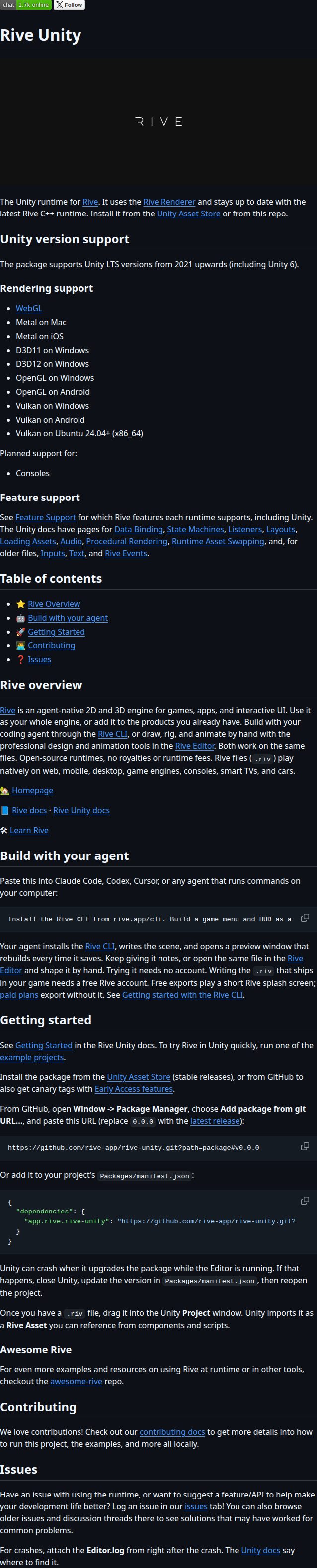 Repository screenshot
rive-app/rive-unity
Unity runtime for Rive, the agent-native 2D and 3D engine for games, apps, and interactive UI.
git clone https://github.com/rive-app/rive-unity.git
Short demos. New discoveries. Less noise in your feed.