Detect Vulnerabilities Before Installation
SkillSpector scans a skill and flags vulnerabilities, malicious patterns, and supply‑chain risks before you install.
NVIDIA/SkillSpector
Security scanner for AI agent skills. Detect vulnerabilities, malicious patterns, security risks, prompt injection, data exfiltration, and supply-chain risks in Claude Code, Codex, and MCP skills before you install them.
THE USEFUL PART
Security scanner for AI agent skills. Detect vulnerabilities, malicious patterns, security risks, prompt injection, data exfiltration, and supply-chain risks in Claude Code, Codex, and MCP skills before you install them.
THE STACKRADAR WALKTHROUGH
A short introduction from our reel. See the project README for the current details.
SkillSpector scans a skill and flags vulnerabilities, malicious patterns, and supply‑chain risks before you install.
Feed a repo, URL, zip or folder and receive a concise security report.
Score risk and receive clear fixes
GITHUB SNAPSHOT
Recorded counts, not a growth rate or a quality score.
OBSERVED STAR HISTORY
Daily source snapshots are collected automatically. A trend appears after at least two real observations—no invented historical growth.

FROM THE PROJECT
Source excerpts from the project's README. Not an independent review, verification or security audit.
Security scanner for AI agent skills. Detect vulnerabilities, malicious patterns, and security risks before installing agent skills.
[](https://www.python.org/downloads/) [](https://www.apache.org/licenses/LICENSE-2.0)
AI agent skills (used by Claude Code, Codex CLI, Gemini CLI, etc.) execute with implicit trust and minimal vetting. In the 31,132-skill analyzed subset of the research dataset, 26.1% of skills contain vulnerabilities and 5.2% show likely malicious intent.
SkillSpector helps you answer: "Is this skill safe to install?"
SkillSpector is part of the NVIDIA Verified Skills pipeline, which scans, evaluates, and signs agent skills before publication. Skills that pass are published to the NVIDIA skills catalog.
Scan agent skills before installation — Hosted guide: when to scan, how to read a report, and how to gate installs.
Development guide — Architecture, package layout, and how to extend the analyzer pipeline.
Security policy — Report suspected vulnerabilities privately to NVIDIA PSIRT.
Analysis resource bounds — Fail-closed bundle, parser, nested-artifact, ledger, and finding ceilings.
Pi extension — Install SkillSpector as a Pi tool for scanning skills from inside agent sessions.
OpenCode extension — Install SkillSpector as an OpenCode tool and /skillspector command for scanning skills from inside agent sessions.
Multi-format input: Scan Git repos, URLs, zip files, directories, or single files
71 vulnerability patterns across 17 categories: prompt injection, data exfiltration, privilege escalation, supply chain, excessive agency, output handling, system prompt leakage, memory poisoning, tool misuse, rogue agent, anti-refusal, trigger abuse, dangerous code (AST), taint tracking, YARA signatures, MCP least privilege, and MCP tool poisoning
Two-stage analysis: Fast static analysis + optional LLM semantic evaluation
Live vulnerability lookups: SC4 queries OSV.dev for real-time CVE data with automatic offline fallback
Multiple output formats: Terminal, JSON, Markdown, and SARIF reports
Risk scoring: 0-100 score with severity labels and clear recommendations
Baseline / false-positive suppression: Accept known findings via a glob-rule or fingerprint baseline so re-scans surface only new issues (docs)
Open-source software notice: This project will download and install additional third-party open source software projects. Review the license terms of these open source projects before use.
Create and activate a virtual environment first (all make targets assume the venv is active). Use uv or pip; the Makefile uses uv if available, otherwise pip.
Quick install with uv (CLI-only):
uv tool install git+https://github.com/NVIDIA/skillspector.git
# Update later: uv tool update skillspector
If you plan to run skillspector mcp, install the MCP extra at install time:
uv tool install 'skillspector[mcp] @ git+https://github.com/NVIDIA/skillspector.git'From source:
# Clone the repository
git clone https://github.com/NVIDIA/skillspector.git
cd skillspector

# Create and activate virtual environment
uv venv .venv && source .venv/bin/activate
# or: python3 -m venv .venv && source .venv/bin/activate

# Install for production use
make install
To contribute, follow the Development setup for a supported Python interpreter and development dependencies.
Run SkillSpector without installing Python by building it locally from the included Dockerfile. The image is based on the Docker Official Python 3.12-slim-bookworm image.
Build the image:
make docker-build
# or: docker build -t skillspector .
Scan a local directory by mounting your current directory into /scan, the container's working directory:
docker run --rm -v "$PWD:/scan" skillspector scan ./my-skill/ --no-llmScan with LLM analysis by passing credentials with a local .env file:
cat > .env <<'EOF'
SKILLSPECTOR_PROVIDER=anthropic
ANTHROPIC_API_KEY=sk-ant-...
EOF
docker run --rm \
-v "$PWD:/scan" \
--env-file .env \
skillspector scan ./my-skill/Or pass credentials directly from your shell environment:
docker run --rm \
  -v "$PWD:/scan" \
  -e SKILLSPECTOR_PROVIDER=anthropic \
  -e ANTHROPIC_API_KEY="$ANTHROPIC_API_KEY" \
  skillspector scan ./my-skill/
Write a report to the host filesystem by writing to the mounted directory:
docker run --rm --user "$(id -u):$(id -g)" \
  -v "$PWD:/scan" \
  skillspector scan ./my-skill/ --no-llm --format json --output report.json
Optional alias for repeated static scans:
alias skillspector-docker='docker run --rm -v "$PWD:/scan" skillspector'
skillspector-docker scan ./my-skill/ --no-llm# Scan a local skill directory
skillspector scan ./my-skill/
# Scan a single SKILL.md file
skillspector scan ./SKILL.md
# Scan a Git repository
skillspector scan https://github.com/user/my-skill
# Scan a zip file
skillspector scan ./my-skill.zipSkillSpector enforces two independent caps on remote and archive inputs to bound the impact of oversized downloads and zip bombs:
Per-ingest cap: INGEST_MAX_BYTES (100 MiB) — applied to streamed URL downloads, total uncompressed size of zip archives, and post-clone disk usage of Git repos.
Zip member cap: INGEST_MAX_ZIP_MEMBERS (10,000) — caps the number of entries in a single zip.
Note that the per-file 1 MB analysis cap (MAX_FILE_BYTES) is a separate, downstream limit: it bounds what individual analyzers will read out of an already-ingested directory. The ingest caps above bound how much content can land on disk in the first place. A breach of either ingest cap fails closed with an IngestLimitExceededError.
# Terminal output (default) - pretty formatted
skillspector scan ./my-skill/

# JSON output - machine readable
skillspector scan ./my-skill/ --format json --output report.json

# Markdown output - for documentation
skillspector scan ./my-skill/ --format markdown --output report.md

# SARIF output - for CI/CD integration and IDE tooling
skillspector scan ./my-skill/ --format sarif --output report.sarif--recursive scans immediate subdirectories containing SKILL.md as independent skills, with a default aggregate limit of 32 skills. To raise or lower it:
skillspector scan ./my-skills/ --recursive --max-skills 100 --no-llm --format json--max-skills requires a local recursive collection and a positive integer; 0 does not mean unlimited. Discovery, byte, finding-record, time and report-size budgets still apply, so increasing the count does not guarantee complete coverage. When the count limit is reached, the CLI names the limit and suggests adjusting it or scanning sub-skills separately. Omitted skills remain visible in the aggregate report and coverage stays incomplete. Use --fail-on-incomplete in CI to fail on incomplete coverage; the default exit policy is unchanged.
Scan entire directories of skills in parallel from contrib/batch_scan/:
python -m contrib.batch_scan.batch_scan ./my-skills/ --no-llm
python -m contrib.batch_scan.batch_scan ./my-skills/ --workers 20 -f json -o report.json
python -m contrib.batch_scan.batch_scan ./tests/fixtures/ -f terminal --workers 20
Supports multilingual detection (zh/ja/ko) and terminal/JSON/Markdown output.
For LLM scans with higher concurrency, configure multiple API keys following .env.example — the pool improves throughput and resilience, provided the keys don't share an account-level rate limit.
See the contrib guide for details.
Note on LLM support: The default configuration targets DeepSeek as the cheapest public option. DeepSeek-Chat is expected to sunset, and the contributor does not have hardware to test against local models. The batch scanner was originally tested with OpenAI-compatible endpoints — DeepSeek's lack of structured-output support required manual JSON-parsing patches. If you can contribute a more universal backend (Ollama, vLLM, or a different provider), PRs are very welcome.
Start with raw registry payload captures (registry-before.json and registry-after.json). Save a scan report as previous.json, then compare a later scan against that generated local report:
skillspector scan registry-before.json --mcp-registry --format json --output previous.json
skillspector scan registry-after.json --mcp-registry --format json \
  --mcp-registry-compare previous.json --output compared.json
The optional comparison object lists added and removed server identities, changed normalized fields with their previous and current values, and an unchanged_count. Identity is the server name and version, so a new version appears as an addition and the old version as a removal if it is absent from the new scan. Acquisition source and scan timestamp are excluded from comparison. unmodeled_changes lists same-identity records whose raw-record hash changed while normalized fields match; these are not counted as unchanged. This can indicate a change to fields outside the snapshot model, or array reordering in the raw record. Package and remote ordering alone is not a normalized field change. Entries in changed may also contain changes outside the snapshot model; inspect the raw record to see those changes. Compare reports with the same selection scope: a server absent from the current input is reported as removed, which does not prove it was removed from a registry.
The comparison file must be a local report produced by this registry mode with valid normalized snapshots. Malformed, oversized or duplicate server identities are rejected. This option requires --mcp-registry and is separate from the finding-suppression --baseline: it never suppresses findings or changes risk scores, and it does not fetch or execute listed server endpoints.
Registry mode rejects skill-only controls such as --use-shipped-baseline, --transitive, --transitive-depth, --transitive-allow-prefix, and --transitive-deny-prefix with exit code 2, including an explicitly supplied default depth (--transitive-depth 1). Omit these options for registry scans.
Suppress known/accepted findings so the risk score reflects only un-triaged issues and re-scans surface only new findings. See the suppression guide for the full reference.
# Accept all current findings into a baseline (run once), then commit it.
skillspector baseline ./my-skill/ -o .skillspector-baseline.yaml

# Scan against the baseline — only NEW findings are reported and scored.
skillspector scan ./my-skill/ --baseline .skillspector-baseline.yaml

# Review what was suppressed (still excluded from the score).
skillspector scan ./my-skill/ --baseline .skillspector-baseline.yaml --show-suppressed
A baseline can also use drift-tolerant glob rules (by rule id, file path, or message) — see .skillspector-baseline.example.yaml. Exact fingerprint baselines are evidence-bound: changing the scanned source or SkillSpector version keeps the finding active until it is reviewed again. When a selected baseline or baseline output is stored inside the skill directory, SkillSpector excludes that exact file from content analysis so its suppression text cannot create findings or enter regenerated fingerprints; sibling files remain in normal scan scope.
For a local directory containing one SKILL.md or skill.md, repeat --exclude to omit selected files before content analysis:
skillspector scan ./my-skill --exclude 'tests/*' --exclude 'fixtures/*.json'Patterns are case-sensitive globs matched against the entire relative POSIX path; also matches /. Quote patterns so your shell does not expand them. This is an explicit caller option, not an author-controlled ignore file. Patterns matching either manifest name (SKILL.md or skill.md) are rejected, as are recursive, multi-skill, transitive, registry, and non-directory inputs. No-match patterns are still recorded in the report.
Files already outside the scan inventory, such as policy-excluded dependencies, retain their existing policy handling and are not counted as caller exclusions. Explicitly excluded inventory files remain in the coverage denominator as entirely uninspected. The report lists the applied patterns, excluded count and individual skipped paths; any matched exclusion makes coverage partial and prevents a SAFE recommendation. Use --fail-on-incomplete when partial scope should fail CI. These exclusions do not suppress findings in included files or override existing safety limits.
For the best results, configure an OpenAI-compatible LLM endpoint for semantic analysis. Pick a provider with SKILLSPECTOR_PROVIDER; hosted providers ship bundled default models, while CLI providers fall back to the local runtime's default model unless SKILLSPECTOR_MODEL is set. SkillSpector also works against local OpenAI-compatible servers (Ollama, vLLM, llama.cpp) and managed inference gateways.
| Provider (SKILLSPECTOR_PROVIDER) | Credential env var | Endpoint | Default model |
|---|---|---|---|
| openai | OPENAI_API_KEY (+ optional OPENAI_BASE_URL) | api.openai.com (or any OpenAI-compatible URL) | gpt-5.4 |
| anthropic | ANTHROPIC_API_KEY | api.anthropic.com | claude-opus-4-6 (meta_analyzer: claude-sonnet-4-6) |
| anthropic_proxy | ANTHROPIC_PROXY_API_KEY + ANTHROPIC_PROXY_ENDPOINT_URL | Any Vertex-style raw-predict proxy | claude-sonnet-4-6 |
| bedrock | AWS_PROFILE (optional) + AWS_REGION — SigV4 via boto3 | AWS Bedrock Runtime | us.anthropic.claude-sonnet-4-6 |
| nv_build | NVIDIA_INFERENCE_KEY | build.nvidia.com | z-ai/glm-5.3 |
| gemini | GOOGLE_CLOUD_PROJECT (+ optional GOOGLE_CLOUD_LOCATION) via ADC | Google Cloud OpenAI-compatible Gemini endpoint | gemini-3.8-flash |
| ollama | (none) | OLLAMA_BASE_URL (default http://localhost:11434/v1) | llama3.1:8b |
| azure_openai | AZURE_OPENAI_API_KEY + AZURE_OPENAI_ENDPOINT | Azure OpenAI Service | gpt-4o (deployment defaults to the model label) |
| openai_compatible | SKILLSPECTOR_COMPAT_API_KEY + SKILLSPECTOR_COMPAT_BASE_URL | Any OpenAI-compatible endpoint | llama-3.1-70b-versatile |
| claude_cli | (none — uses local CLI auth) | local claude binary | local Claude runtime fallback, or SKILLSPECTOR_MODEL |
| codex_cli | Disabled | Registered for compatibility; its read-only sandbox permits host-file reads | Use an HTTP API provider or another supported CLI provider |
| gemini_cli | (none — uses local CLI auth) | local gemini binary | local Gemini runtime fallback, or SKILLSPECTOR_MODEL |
| opencode_cli | (none — uses local CLI auth) | local opencode (verified 1.18.31–1.18.35, 1.19.0–1.19.4) binary | local OpenCode runtime fallback, or SKILLSPECTOR_MODEL |
For openai_compatible gateways requiring extra HTTP headers, set SKILLSPECTOR_COMPAT_HEADERS='{"X-Tenant-ID":"my-tenant","X-API-Key":"gateway-key"}'. It must be a JSON object with string keys and values and applies to sync and async requests. Unset or blank values add no headers; invalid configuration is rejected without exposing header values. Treat this environment variable as a secret when it contains gateway API keys.
gpt-6.1-sol, claude-opus-5-5, and claude-sonnet-5-5 remain opt-in through SKILLSPECTOR_MODEL or per-slot overrides. Promoting them to defaults requires live scanner acceptance covering benign input, credential disclosure, prompt injection, refusals, and incomplete responses. Record findings, completion status, latency, and usage, and compare against previous defaults where accessible.
For NVIDIA Build's z-ai/glm-5.3, SkillSpector requests high reasoning effort. Set SKILLSPECTOR_REASONING_EFFORT to override it with low, high, or max. The bundled 128,000-token context and 32,000-token output budgets are conservative application limits; they do not claim the hosted endpoint's maximum capacity.
Structured output is requested through LangChain's with_structured_output. The default is client-specific: ChatOpenAI uses json_schema, while other clients may use tool calling. Some models reject a forced tool call with HTTP 400 (tool_choice: type "tool" and "any" are not supported for this model). The anthropic and anthropic_proxy providers route those models (claude-opus-5-5, claude-sonnet-5-5, claude-fable-5-1, claude-mythos-5-1, or any registry entry with structured_output: json_schema) to the native JSON-schema response format. Bedrock has no JSON-schema output for them, so the bedrock provider leaves toolChoice at auto, asks for the tool call in the prompt, and retries a prose answer; it recognises the model from the model ID, a geo/global inference-profile ID, or a foundation-model / inference-profile ARN. An application-inference-profile ARN hides the model, so add that ARN to the registry (SKILLSPECTOR_MODEL_REGISTRY) with tool_choice: auto. The openai_compatible provider honours the same tool_choice: auto entry for endpoints that ignore both response_format and a forced tool_choice and answer in prose (for example iFlytek's spark-x2.5, which is bundled). The anthropic, anthropic_proxy, openai, and openai_compatible providers also recognise those Claude models inside gateway model IDs such as anthropic/claude-opus-5-5 or aws/anthropic/bedrock-claude-opus-5-5. Some OpenAI-compatible gateways turn a json_schema response format for Claude into a forced tool call, so the openai and openai_compatible providers bind the schema as a tool with tool_choice left at auto and retry a prose answer. SKILLSPECTOR_STRUCTURED_OUTPUT_METHOD=json_schema|function_calling overrides the method for any provider. The method precedence is SKILLSPECTOR_STRUCTURED_OUTPUT_METHOD, the provider's method hint, an analyzer preference, then the client default. TP4 prefers function_calling only for provider openai and the exact model label azure/anthropic/claude-opus-5, with reasoning/thinking controls unset; dated or suffixed labels and other providers keep their existing behavior. An explicit environment override or provider hint still wins when reasoning is configured.
# Stock OpenAI
export SKILLSPECTOR_PROVIDER=openai
export OPENAI_API_KEY=sk-...
skillspector scan ./my-skill/

# Anthropic
export SKILLSPECTOR_PROVIDER=anthropic
export ANTHROPIC_API_KEY=sk-ant-...
skillspector scan ./my-skill/

# Anthropic via Vertex-style proxy (corporate gateways, GCP Vertex AI)
export SKILLSPECTOR_PROVIDER=anthropic_proxy
export ANTHROPIC_PROXY_ENDPOINT_URL=https://my-gateway.example.com/models/claude-sonnet-4-6:streamRawPredict
export ANTHROPIC_PROXY_API_KEY=your-bearer-token
export SKILLSPECTOR_MODEL=claude-sonnet-4-6
skillspector scan ./my-skill/

# AWS Bedrock (Claude via SigV4)
export SKILLSPECTOR_PROVIDER=bedrock
# Optional: select an AWS named profile. When unset, the standard
# boto3 credential chain (env vars, instance metadata, SSO, etc.) resolves.
# export AWS_PROFILE=my-profile
export AWS_REGION=us-west-2  # default if unset
# Default model: us.anthropic.claude-sonnet-4-6
# Override with any Bedrock model ID, cross-region inference-profile
# ID, or your own application-inference-profile ARN. Claude 5.5 is opt-in:
# us./eu. profiles keep requests in that geography, global. routes worldwide.
# export SKILLSPECTOR_MODEL=us.anthropic.claude-sonnet-5-5
skillspector scan ./my-skill/

# NVIDIA build.nvidia.com
export SKILLSPECTOR_PROVIDER=nv_build
export NVIDIA_INFERENCE_KEY=nvapi-...
skillspector scan ./my-skill/

# Gemini on Google Cloud (Application Default Credentials / Workload Identity)
# Prerequisites:
#   1. Google Cloud project with billing enabled.
#   2. Enable Gemini Enterprise Agent Platform / Vertex AI API: `aiplatform.googleapis.com`.
#   3. IAM permission: grant `roles/aiplatform.user` (or at minimum `aiplatform.endpoints.predict`)
#      to your user account or Kubernetes service account.
#   4. Local authentication: run `gcloud auth application-default login`.
#      Configure a quota project if needed: `gcloud auth application-default set-quota-project PROJECT_ID`.
#   5. Kubernetes / GKE: configure Workload Identity and leave GOOGLE_APPLICATION_CREDENTIALS unset
#      rather than exporting service account keys.
# Note on Data Residency:
#   The default `global` endpoint does not support data-residency requirements. While you can target
#   `us`, `eu`, or regional endpoints (e.g. `us-central1`), endpoint selection alone does not guarantee
#   data residency or in-region processing without appropriate organizational policies. Always verify
#   that your selected model is supported in your target location.
# Optional credentials:
#   GOOGLE_APPLICATION_CREDENTIALS is optional and can reference Workload or Workforce Identity Federation
#   configuration files; exporting long-lived service account keys is discouraged.
export SKILLSPECTOR_PROVIDER=gemini
export GOOGLE_CLOUD_PROJECT=my-project-id
# export GOOGLE_CLOUD_LOCATION=global  # default is global; or us, eu, or specific region (e.g. us-central1)
# Default model: gemini-3.8-flash
# export SKILLSPECTOR_MODEL=gemini-3.7-flash
skillspector scan ./my-skill/

# Local Claude CLI — no API key; uses your existing `claude auth login` session
# Requires: claude CLI installed and authenticated (claude auth login)
export SKILLSPECTOR_PROVIDER=claude_cli
# Uses the local Claude CLI runtime fallback unless SKILLSPECTOR_MODEL is set.
# export SKILLSPECTOR_MODEL=claude-sonnet-4-6
skillspector scan ./my-skill/

# Gemini (via OpenAI compatibility layer)
export SKILLSPECTOR_PROVIDER=openai
export OPENAI_API_KEY="YOUR_GEMINI_API_KEY"
export OPENAI_BASE_URL="https://generativelanguage.googleapis.com/v1beta/openai/"
export SKILLSPECTOR_MODEL=gemini-3.5-flash
skillspector scan ./my-skill/

# Local Ollama — no API key
export SKILLSPECTOR_PROVIDER=ollama
# export OLLAMA_BASE_URL=http://localhost:11434/v1  # shown default
export SKILLSPECTOR_MODEL=llama3.1:8b
skillspector scan ./my-skill/

# Azure OpenAI
export SKILLSPECTOR_PROVIDER=azure_openai
export AZURE_OPENAI_API_KEY=...
export AZURE_OPENAI_ENDPOINT=https://example.openai.azure.com/
export AZURE_OPENAI_DEPLOYMENT=my-deployment
skillspector scan ./my-skill/

# Any other OpenAI-compatible endpoint
export SKILLSPECTOR_PROVIDER=openai_compatible
export SKILLSPECTOR_COMPAT_API_KEY=...
export SKILLSPECTOR_COMPAT_BASE_URL=https://api.groq.com/openai/v1
export SKILLSPECTOR_MODEL=llama-3.1-70b-versatile
skillspector scan ./my-skill/

# Override the provider's default model
export SKILLSPECTOR_MODEL=gpt-5.2
skillspector scan ./my-skill/

# Skip LLM analysis (faster, static analysis only)
skillspector scan ./my-skill/ --no-llmRun SkillSpector as a Model Context Protocol server so local MCP-capable agents (Claude Code, Codex CLI, Gemini CLI) can call scanning as a tool and gate skill/MCP installs on the result — turning SkillSpector into a runtime guardrail instead of an out-of-band audit step.
skillspector mcp requires skillspector[mcp].
# Install, or reinstall if you already used the CLI-only path
uv tool install --force 'skillspector[mcp] @ git+https://github.com/NVIDIA/skillspector.git'

# FastMCP stdio transport for local CLI agents
skillspector mcp

# Streamable HTTP transport on a local loopback interface
skillspector mcp --transport http --host 127.0.0.1 --port 8000
The stdio transport is the current FastMCP path for local CLI agents, and the initialize hang reported in issue #199 still applies there.
The server exposes a single tool:
scan_skill(target, use_llm=true, output_format="json") — scans a Git
URL, file URL, .zip, .md file, or directory and returns a structured verdict: risk_score (0-100), severity, recommendation, safe_to_install, and findings. It also reports llm_used / scan_mode so a low score from a static-only scan is never mistaken for a clean full scan.
Register it with Claude Code via:
claude mcp add skillspector -- skillspector mcpSecurity — HTTP transport trust model The HTTP transport ships without authentication. Any caller that can reach the port can invoke scan_skill. HTTP bindings are restricted to loopback IPs (127.0.0.1 or ::1); localhost binds to 127.0.0.1 without DNS resolution. Wildcard, routable and other hostname bindings are rejected. - For remote access, put an authenticating reverse proxy (e.g. nginx + mTLS) in front of the loopback listener. - Local paths and file:// URLs are automatically rejected over HTTP to prevent unauthenticated callers from reading arbitrary host files. Only remote Git and .zip URLs are accepted. HTTP scans accept only credential-free https:// targets. Git scans never use the server's Git login or Git config. If a proxy or custom CA is needed, set HTTPS_PROXY, NO_PROXY or GIT_SSL_CAINFO in the server environment. Use stdio or the CLI for private repositories. Git redirects are rejected; use the current repository URL after a rename or transfer.
SkillSpector detects 71 vulnerability patterns across 17 categories:
| ID | Pattern | Severity | Description |
|---|---|---|---|
| P1 | Instruction Override | HIGH | Commands to ignore safety constraints |
| P2 | Hidden Instructions | HIGH | Malicious directives in comments/invisible text |
| P3 | Exfiltration Commands | HIGH | Instructions to transmit context externally |
| P4 | Behavior Manipulation | MEDIUM | Subtle instructions altering agent decisions |
| P5 | Harmful Content | CRITICAL | Instructions that could cause physical harm |
| P9 | Whitespace Padding | MEDIUM | Large whitespace padding hiding instructions below/beside the visible area |
| ID | Pattern | Severity | Description |
|---|---|---|---|
| AR1 | Refusal Suppression | HIGH | Instructions to never refuse or always comply (e.g. "never refuse", "always comply") |
| AR2 | Disclaimer Suppression | HIGH | Instructions to omit warnings, disclaimers, or ethical commentary (e.g. "no disclaimers", "do not moralize") |
| AR3 | Safety Policy Nullification | HIGH | Jailbreak framing that nullifies guardrails (e.g. "you have no restrictions", "ignore your guidelines", "do anything now") |
| ID | Pattern | Severity | Description |
|---|---|---|---|
| E1 | External Transmission | MEDIUM | Sending data to external URLs |
| E2 | Env Variable Harvesting | HIGH | Enumerating, copying, or searching environment data to collect secrets |
| E3 | File System Enumeration | MEDIUM | Scanning directories for sensitive files |
| E4 | Context Leakage | HIGH | Transmitting conversation context externally |
| ID | Pattern | Severity | Description |
|---|---|---|---|
| PE1 | Excessive Permissions | LOW | Requesting access beyond stated functionality |
| PE2 | Sudo/Root Execution | MEDIUM | Invoking elevated system privileges |
| PE3 | Credential Access | HIGH | Reading SSH keys, tokens, passwords |
| ID | Pattern | Severity | Description | |
|---|---|---|---|---|
| SC1 | Unpinned Dependencies | LOW | No version constraints on packages | |
| SC2 | External Script Fetching | HIGH | curl \ | bash and remote code execution |
| SC3 | Obfuscated Code | HIGH | Base64/hex encoded execution | |
| SC4 | Known Vulnerable Dependencies | HIGH | Dependencies with known CVEs (live OSV.dev lookup) | |
| SC5 | Abandoned Dependencies | MEDIUM | Unmaintained packages without security updates | |
| SC6 | Typosquatting | HIGH | Package names similar to popular packages | |
| SC8 | Shipped Python Bytecode | HIGH | pycache / .pyc present (discovery skips; malicious bytecode bypass) | |
| SC9 | Concealed Executable Artifact | HIGH | Executable nested in a document container or hidden/disguised artifact; root-level visible source helpers in manifested .agents/skills/ / and .claude/skills/ / folders are exempted but remain local-only and are marked as not LLM-reviewed | |
| SC10 | Dependency Source Redirection | HIGH | Package-manager source added, replaced, or unresolved |
| ID | Pattern | Severity | Description |
|---|---|---|---|
| EA1 | Unrestricted Tool Access | HIGH | Unfettered tool access without constraints |
| EA2 | Autonomous Decision Making | HIGH | High-impact decisions without human-in-the-loop |
| EA3 | Scope Creep | MEDIUM | Capabilities extending beyond stated purpose |
| EA4 | Unbounded Resource Access | MEDIUM | No rate limits or quotas on resource consumption |
| EA5 | External Model or Provider Selection | MEDIUM/HIGH | Model/provider pins or coding-CLI shell-outs that can switch billing accounts |
| ID | Pattern | Severity | Description |
|---|---|---|---|
| OH1 | Unvalidated Output Injection | HIGH | Model output used without sanitization |
| OH2 | Cross-Context Output | MEDIUM | Output flows across trust boundaries without validation |
| OH3 | Unbounded Output | MEDIUM | No limits on output size or generation rate |
| ID | Pattern | Severity | Description |
|---|---|---|---|
| P6 | Direct Leakage | HIGH | Instructions that expose system prompts or internal rules |
| P7 | Indirect Extraction | MEDIUM | Extraction via rephrasing, translation, or side-channels |
| P8 | Tool-Based Exfiltration | HIGH | System prompts exfiltrated via file writes or network requests |
| ID | Pattern | Severity | Description |
|---|---|---|---|
| MP1 | Persistent Context Injection | HIGH | Content designed to persist across interactions |
| MP2 | Context Window Stuffing | MEDIUM | Filler content displacing safety constraints |
| MP3 | Memory Manipulation | HIGH | Tampering with agent memory or stored state |
| ID | Pattern | Severity | Description |
|---|---|---|---|
| TM1 | Tool Parameter Abuse | HIGH | Crafted parameters for unintended behavior (shell=True, --force) |
| TM2 | Chaining Abuse | HIGH | Tool chains that bypass individual safety checks |
| TM3 | Unsafe Defaults | MEDIUM | Overly permissive defaults (disabled TLS, no auth) |
| ID | Pattern | Severity | Description |
|---|---|---|---|
| RA1 | Self-Modification | CRITICAL | Modifying own code or configuration at runtime |
| RA2 | Session Persistence | HIGH | Unauthorized persistence via cron jobs or startup scripts |
| ID | Pattern | Severity | Description |
|---|---|---|---|
| TR1 | Overly Broad Trigger | MEDIUM | Trigger patterns matching common words |
| TR2 | Shadow Command Trigger | HIGH | Triggers that shadow built-in commands or other skills |
| TR3 | Keyword Baiting Trigger | MEDIUM | Generic triggers designed to maximize activation |
| ID | Pattern | Severity | Description |
|---|---|---|---|
| AST1 | exec() Call | CRITICAL | Direct exec() enabling arbitrary code execution |
| AST2 | eval() Call | HIGH | Direct eval() evaluating arbitrary expressions |
| AST3 | Dynamic Import | HIGH | \\import\\() loading arbitrary modules at runtime |
| AST4 | subprocess Call | HIGH | External command execution via subprocess |
| AST5 | os.system / exec-family | HIGH | Shell commands via os module |
| AST6 | compile() Call | MEDIUM | Code object creation from strings |
| AST7 | Dynamic getattr() | MEDIUM | Arbitrary attribute access with non-literal names |
| AST8 | Dangerous Execution Chain | CRITICAL | exec/eval combined with dynamic source (network, encoded data) |
| AST9 | Reflective getattr() Sink | HIGH | Reflective exec via getattr(os,'system') / getattr(builtins,'exec') that evades AST1/AST5 |
| ID | Pattern | Severity | Description |
|---|---|---|---|
| TT1 | Direct Taint Flow | HIGH | Data flows directly from a source to a sink without sanitization |
| TT2 | Variable-Mediated Taint Flow | MEDIUM | Data flows from source to sink through intermediate variables |
| TT3 | Credential Exfiltration Chain | CRITICAL | Credentials (env vars, secrets) flow to network output sinks |
| TT4 | File Read to Network Exfiltration | HIGH | File contents flow to network output sinks |
| TT5 | External Input to Code Execution | CRITICAL | Network or user input flows to exec/eval/subprocess sinks |
| ID | Pattern | Severity | Description |
|---|---|---|---|
| YR1 | Malware Match | CRITICAL | YARA rule match for known malware signatures |
| YR2 | Webshell Match | CRITICAL | YARA rule match for webshell patterns |
| YR3 | Cryptominer Match | HIGH | YARA rule match for crypto mining indicators |
| YR4 | Hack Tool / Exploit Match | HIGH | YARA rule match for hack tools or exploit code |
| ID | Pattern | Severity | Description |
|---|---|---|---|
| LP1 | Underdeclared Capability | HIGH | Code uses capabilities not listed in declared permissions |
| LP2 | Wildcard Permission | MEDIUM | Permission list contains wildcards (\, all, full, any) |
| LP3 | Missing Permission Declaration | MEDIUM | No permissions field but code has detectable capabilities |
| LP4 | Overdeclared Permission | LOW | Permission declared but no corresponding code capability found |
| ID | Pattern | Severity | Description |
|---|---|---|---|
| TP1 | Hidden Instructions | HIGH | Hidden directives in metadata (HTML comments, zero-width chars, base64, data URIs) |
| TP2 | Unicode Deception | HIGH | Homoglyphs, RTL overrides, mixed-script identifiers in tool metadata |
| TP3 | Parameter Description Injection | MEDIUM | Injection patterns in parameter definitions (overrides, system tokens, malicious defaults) |
| TP4 | Description-Behavior Mismatch | MEDIUM | Declared tool description does not match actual code behavior (LLM-powered) |
All detected patterns are listed in the tables above.
CRITICAL issues: +50 points
HIGH issues: +25 points
MEDIUM issues: +10 points
LOW issues: +5 points
Executable scripts: 1.3x multiplier
| Score | Severity | Recommendation |
|---|---|---|
| 0-20 | LOW | SAFE |
| 21-50 | MEDIUM | CAUTION |
| 51-80 | HIGH | DO NOT INSTALL |
| 81-100 | CRITICAL | DO NOT INSTALL |
 SkillSpector Security Report  v2.0.0

Skill: suspicious-skill
Source: ./suspicious-skill/
Scanned: 2026-01-29 10:30:00 UTC

        Risk Assessment
 Metric          Value
 Score           78/100
 Severity        HIGH
 Recommendation  DO NOT INSTALL

        Components (3)
 File              Type      Lines  Executable
 SKILL.md          markdown    142  No
 scripts/sync.py   python       87  Yes
 requirements.txt  text          3  No

Issues (2)

  HIGH: Env Variable Harvesting (E2)
    Location: scripts/sync.py:23
    Finding: for key, val in os.environ.items():...
    Confidence: 94%
    Explanation: This code collects environment variables containing
    API keys and secrets, then sends them to an external server.

  HIGH: External Transmission (E1)
    Location: scripts/sync.py:45
    Finding: requests.post("https://api.skill.io/env"...
    Confidence: 89%
    Explanation: Data is being sent to an external server. Combined
with env harvesting above, this indicates credential exfiltration.| Variable | Description | Required |
|---|---|---|
| SKILLSPECTOR_PROVIDER | Active LLM provider: openai, anthropic, anthropic_proxy, bedrock, nv_build, gemini, ollama, azure_openai, openai_compatible, claude_cli, gemini_cli, or opencode_cli. Hosted providers use bundled model_registry.yaml defaults; CLI providers fall back to the local runtime's default model unless SKILLSPECTOR_MODEL is set. Defaults to nv_build. | Optional |
| GOOGLE_CLOUD_PROJECT | Google Cloud project ID for the gemini provider. Authenticates via Google Cloud Application Default Credentials (ADC) or GKE Workload Identity. | Required for LLM analysis when SKILLSPECTOR_PROVIDER=gemini |
| GOOGLE_CLOUD_LOCATION | Google Cloud location for the gemini provider endpoint (e.g. global, us, eu, us-central1). Defaults to global. | Optional (used when SKILLSPECTOR_PROVIDER=gemini) |
| GOOGLE_APPLICATION_CREDENTIALS | Optional path to ADC credential/config file (e.g. Workload or Workforce Identity Federation config; exported service account keys are discouraged). For local development, use gcloud auth application-default login; for GKE, use Workload Identity. | Optional (used when SKILLSPECTOR_PROVIDER=gemini) |
| NVIDIA_INFERENCE_KEY | Credential for the nv_build provider (build.nvidia.com). | Required for LLM analysis when SKILLSPECTOR_PROVIDER=nv_build |
| OPENAI_API_KEY | Credential for the OpenAI provider (SKILLSPECTOR_PROVIDER=openai). Also serves as the tier-2 fallback in the credential waterfall when the active provider returns no credentials; the fallback then uses the openai default model (gpt-5.4) for any slot without a model override. Claude Opus or Sonnet 5.5 gateway IDs are not supported through the fallback, because it keeps the active provider's structured-output method; select SKILLSPECTOR_PROVIDER=openai for them. | Required for LLM analysis when SKILLSPECTOR_PROVIDER=openai |
| OPENAI_BASE_URL | Override the OpenAI endpoint (e.g. point at Ollama). | Optional |
| SKILLSPECTOR_REASONING_EFFORT | Optional provider- and model-dependent reasoning-effort setting. Non-empty values are trimmed and passed through unchanged. When unset or blank, SkillSpector sends high for nv_build with z-ai/glm-5.3; other provider/model combinations keep their endpoint defaults. The value applies to every model slot, so the anthropic meta_analyzer default receives the same effort as the analyzers. gpt-6.1-sol accepts only low, medium, high, xhigh, or max; any other value stops a scan before analysis (exit code | Optional |
| SKILLSPECTOR_OUTPUT_LANGUAGE | Short, single-line language label (letters, numbers, spaces, , or -; maximum 64 characters) for human-readable LLM finding text such as messages, explanations, and remediation. Rule IDs, severity values, paths, code, and other machine-readable values remain unchanged. Unset, blank, or invalid values preserve the default output language. | Optional |
| SKILLSPECTOR_TEMPERATURE | Optional sampling temperature from 0 to 1 for hosted providers. Unset or blank preserves the provider default. Lower values can reduce run-to-run variation but do not guarantee identical output. gpt-6.1-sol rejects every explicit temperature, including 1. Claude Opus 4.7 and later, Sonnet 5, Fable 5, Mythos 5 and Haiku 5 models (for example claude-opus-5-5, claude-fable-5-1, claude-haiku-5-5) accept only 1.0 on the native Anthropic endpoint (API compatibility rule); gateways, proxies, and Bedroc | Optional |
| SKILLSPECTOR_SEED | Optional integer sampling seed for OpenAI-compatible and Azure OpenAI providers. Other hosted providers and CLI providers do not receive it. Provider support remains model-dependent; gpt-6.1-sol receives it, but OpenAI treats seed as best-effort, so output can still differ between runs. | Optional |
| SKILLSPECTOR_COMPACT_PROMPTS | Opt-in compact line numbering in LLM prompts: numbered lines render as L1:, L2: instead of zero-padded L01:, L02:. Accepted truthy values are 1, true, and yes (case-insensitive; surrounding whitespace is trimmed). Unset or any other value keeps the default zero-padded format. | Optional |
| ANTHROPIC_API_KEY | Credential for the Anthropic provider (SKILLSPECTOR_PROVIDER=anthropic). | Required for LLM analysis when SKILLSPECTOR_PROVIDER=anthropic |
| ANTHROPIC_BASE_URL | Override the native Anthropic endpoint (default: https://api.anthropic.com). | Optional |
| ANTHROPIC_AUTH_SCHEME | Set to bearer to send ANTHROPIC_API_KEY as Authorization: Bearer instead of x-api-key, for gateways exposing the Messages API. | Optional |
| ANTHROPIC_PROXY_ENDPOINT_URL | Full endpoint URL for the Anthropic proxy provider (Vertex-style raw-predict). | Required when SKILLSPECTOR_PROVIDER=anthropic_proxy |
| ANTHROPIC_PROXY_API_KEY | Bearer token for the Anthropic proxy provider. | Required when SKILLSPECTOR_PROVIDER=anthropic_proxy |
| ANTHROPIC_PROXY_API_VERSION | anthropic_version value sent in the request body (default: vertex-2023-10-16). | Optional |
| AWS_PROFILE | Named AWS profile for the Bedrock provider — authenticates via SigV4 through boto3. When unset, the standard boto3 credential chain (env vars, instance metadata, SSO, etc.) resolves. | Optional (used when SKILLSPECTOR_PROVIDER=bedrock) |
| AWS_REGION | AWS region for the Bedrock Runtime endpoint. Defaults to us-west-2. | Optional (used when SKILLSPECTOR_PROVIDER=bedrock) |
| OLLAMA_BASE_URL | Ollama OpenAI-compatible endpoint. Defaults to http://localhost:11434/v1. | Optional (used when SKILLSPECTOR_PROVIDER=ollama) |
| AZURE_OPENAI_API_KEY | API key for the Azure OpenAI provider. | Required when SKILLSPECTOR_PROVIDER=azure_openai |
| AZURE_OPENAI_ENDPOINT | Azure resource endpoint for the Azure OpenAI provider. | Required when SKILLSPECTOR_PROVIDER=azure_openai |
| AZURE_OPENAI_DEPLOYMENT | Azure deployment name. Defaults to the selected model label. | Optional |
| AZURE_OPENAI_API_VERSION | Azure OpenAI API version. Defaults to 2024-06-01. | Optional |
| SKILLSPECTOR_COMPAT_API_KEY | API key for a generic OpenAI-compatible provider. | Required when SKILLSPECTOR_PROVIDER=openai_compatible |
| SKILLSPECTOR_COMPAT_BASE_URL | Base URL for a generic OpenAI-compatible provider. | Required when SKILLSPECTOR_PROVIDER=openai_compatible |
| SKILLSPECTOR_MODEL | Override the active provider model. For hosted providers, this replaces the bundled default from the LLM Analysis table. For CLI providers, this is forwarded as --model instead of using the local runtime fallback. | Optional |
| SKILLSPECTOR_MODEL | Override the model for one analyzer slot (for example SKILLSPECTOR_MODEL_META_ANALYZER). It takes precedence over SKILLSPECTOR_MODEL, which in turn replaces provider slot defaults such as the anthropic meta_analyzer default. See model provenance for the full precedence. | Optional |
| SKILLSPECTOR_MODEL_REGISTRY | Override the bundled per-provider YAML registry (src/skillspector/providers/ /model_registry.yaml) with a custom path. | Optional |
| SKILLSPECTOR_LOG_LEVEL | Log level: DEBUG, INFO, WARNING, ERROR (default: WARNING). | Optional |
| SKILLSPECTOR_MAX_WORKFLOW_SECONDS | Aggregate scan deadline in seconds; defaults to 1080 (18 minutes). Accepts a positive finite number. Invalid values warn and retain the default. Set before starting the process; caller-supplied budgets and external tool timeouts still apply. | Optional |
| SKILLSPECTOR_TP4_MAX_BATCHES | Maximum description-behavior review batches per TP4 analyzer execution; defaults to 256. Accepts an integer from 1 to 4096. Unset or blank uses the default; invalid values warn and retain it. Set before starting the process; file, byte, finding, concurrency, and workflow-time limits still apply. | Optional |
| SKILLSPECTOR_MAX_DEPENDENCY_SOURCE_ANALYSIS_SECONDS | Ceiling for the dependency-source analysis pass, in seconds. Defaults to 5.0, which is the historical value. Raise it on slow or heavily loaded machines so the same unchanged tree does not come back partially inspected, which would set safe_to_install to false and record runtime_limit. The remaining aggregate workflow time (SKILLSPECTOR_MAX_WORKFLOW_SECONDS, 1080 seconds by default) still caps the effective value; values above that remaining time have no effect. Invalid, zero, negative, infinite | Optional |
Disabled provider: codex_cli remains registered but cannot run LLM analysis because its read-only sandbox allows host-file reads. Existing users should select an HTTP API provider or another supported CLI provider.
CLI providers (claude_cli, gemini_cli, opencode_cli): No API key is needed. Authentication is managed entirely by the agent CLI's own login session. SkillSpector never reads or forwards API keys when these providers are active. The subprocess is run with capabilities restricted, and untrusted skill content is delivered only via stdin. opencode_cli currently fails closed unless the installed OpenCode version is one of the individually verified releases (1.18.31, 1.18.32, 1.18.33, 1.18.34, 1.18.35, 1.19.0, 1.19.1, 1.19.2, 1.19.3, 1.19.4), whose configuration precedence and deny-all semantics are verified by this release; every other version, including prereleases, still fails closed.
skillspector scan --help

Options:
  -f, --format [terminal|json|markdown|sarif]  Output format [default: terminal]
  -o, --output PATH                            Output file path
  --no-llm                                     Skip LLM analysis (static only)
  --yara-rules-dir PATH                        Extra YARA rules directory
  -b, --baseline PATH                          Suppress findings listed in a baseline
  --show-suppressed                            List baseline-suppressed findings
  -V, --verbose                                Show detailed progress
  --help                                       Show this message and exit

# Generate a baseline of all current findings (see docs/SUPPRESSION.md)
skillspector baseline <path> [-o FILE] [--no-llm] [--reason TEXT]
Report files and new baselines use private permissions (0600). Existing baselines retain their access metadata when safely replaced; updates requiring in-place writes are refused. All file output uses atomic replacement. The parent directory must be writable; symlinked parents and non-regular destinations such as devices are refused. On macOS, ancestor directories must also be readable. File output requires POSIX no-follow directory operations and is unavailable on Windows. Unsupported file output fails before analysis. Omit --output for scan/batch stdout, or use skillspector baseline -o - for JSON on stdout, then redirect only to a trusted destination. Run Docker with your user ID as above so you can read its files.
SkillSpector is built to be driven by other tools (CI pipelines, install gates, editor integrations). Its exit code and JSON output are a stable contract.
skillspector scan exits with:
| Code | Meaning |
|---|---|
| 0 | Scan completed, risk_score ≤ 50 (recommendation SAFE or CAUTION), and no enabled strict gate fired |
| 1 | Scan completed and either risk_score > 50, --fail-on-findings found an active finding, --fail-on-incomplete found partial/incomplete analysis, or --min-coverage found coverage below its threshold |
| 2 | Error (bad input, unreadable source, internal failure) |
By default, the exit code collapses SAFE and CAUTION into 0. Use --fail-on-findings to gate on any active finding, --fail-on-incomplete to gate on incomplete coverage, --min-coverage PERCENT to gate on a coverage floor, or read the JSON recommendation field for custom policy.
--format json produces a JSON report; with no --output/-o it is written to stdout:
skillspector scan ./my-skill/ --format jsonThe top-level shape is (this example shows a full LLM-backed scan; with --no-llm, metadata.llm_requested is false):
{
  "skill": { "name": "...", "source": "...", "scanned_at": "<ISO 8601>" },
  "risk_assessment": { "score": 0, "severity": "LOW", "recommendation": "SAFE" },
  "components": [ { "path": "...", "type": "...", "lines": 0, "executable": false, "size_bytes": 0 } ],
  "issues": [ { "id": "...", "category": "...", "severity": "...", "confidence": 0.0, "location": { "file": "...", "start_line": 0 }, "surface": "code" } ],
  "metadata": {
    "has_executable_scripts": false,
    "skillspector_version": "...",
    "llm_requested": true,
    "llm_available": true,
    "inference_usage": [
      {
        "node": "semantic_security_discovery",
        "request_kind": "structured_output",
        "provider": "nv_inference",
        "model": "azure/anthropic/claude-opus-4-6",
        "model_source": "provider_response",
        "usage_source": "provider_response",
        "prompt_tokens": 1000,
        "completion_tokens": 100,
        "cached_tokens": 400,
        "cache_write_tokens": 50,
        "total_tokens": 1100
      }
    ]
  }
}
risk_assessment.severity ∈ LOW | MEDIUM | HIGH | CRITICAL.
risk_assessment.recommendation ∈ SAFE | CAUTION | DO_NOT_INSTALL, mapped from severity: LOW → SAFE, MEDIUM → CAUTION, HIGH/CRITICAL → DO_NOT_INSTALL.
issues[].surface and suppressed[].surface are advisory, heuristic labels for where a finding landed:
code | instructions | docs | tests | comments | config. JSON expands compacted groups into one issues[] entry per occurrence, each with its own surface; SARIF emits properties.surface on each result. The label is path/line-based and the scanned author can influence it, so do not use it as the sole suppression or security signal.
metadata.llm_error appears only when LLM analysis was requested but unavailable.
Archive-member components retain their virtual path and include outer_path, nested_path,
and container provenance. Virtual paths identify in-memory members, not on-disk files; see JSON component locations.
AE1 findings use Incomplete referenced artifact analysis. Their source
location identifies the reference; evidence identifies the affected target, analyzer reasons, and available bounds. Review the target's completeness ledger when reasons_truncated is true. See referenced-artifact diagnostics and Perl help text for interpretation and corrective actions.
metadata.inference_usage contains one sanitized record per LLM response when the
provider exposes token counters. It is an empty list when usage is unavailable; SkillSpector never estimates missing tokens. Prompt totals are inclusive of cache reads and writes so downstream pricing can separate those partitions safely. model_source distinguishes an independently identified provider model from the exact requested model used when response identity is absent or ambiguous. SkillSpector does not currently send Anthropic prompt-cache controls, so its scan requests cannot select the separate 5-minute or 1-hour cache-write tiers; TTL-specific response fields are normalized defensively into the aggregate cache-write counter.
See Inference usage telemetry for the complete
provenance, cache-accounting, privacy, fail-closed ingestion, and downstream pricing contract.
The full per-issue shape is defined by Finding.to_dict() in models.py; rely on the fields above and treat any additional fields as best-effort.
For CI/IDE tooling, --format sarif emits SARIF 2.1.0. Each result carries its security severity; rule descriptors carry a score only when all of their results share that severity. Mixed-severity rules remain unannotated, so consumers that read only rule-level severity cannot distinguish their result severities. Recursive scans chain each percent-encoded skill-directory URI through an absolute scan-root file URI. External dependency locations retain their source provenance instead of being rebased into the local skill directory.
When using SkillSpector as an install gate, map the recommendation to an action:
| recommendation | Suggested action |
|---|---|
| SAFE | allow |
| CAUTION | prompt / warn the user |
| DO_NOT_INSTALL | block |
SkillSpector computes the score band and recommendation; how strict the gate is (e.g. whether CAUTION blocks in CI) is a policy decision for the integrating tool.
This is the canonical setup recipe for contributing from this checkout. Use Python 3.12-3.15 (>=3.12,<3.16, as defined in pyproject.toml), Git, and make. A release tag can have a different Python range; check that tag's metadata. The commands below use Bash or Zsh.
With uv installed:
git clone https://github.com/NVIDIA/skillspector.git
cd skillspector
uv venv --python 3.12 .venv
source .venv/bin/activate
make install-dev
If uv is not installed, clone the repository and enter it as above, then use an installed supported Python interpreter with venv and pip:
python3.12 -m venv .venv
source .venv/bin/activate
make install-dev
Create and activate the virtual environment before running any make target. make install-dev uses uv sync --all-extras when uv is available, otherwise pip install -e ".[dev]".
Start with these local checks:
make test-unit
make lint
make format-check
make test-unit excludes tests marked integration or provider. This selection does not cover every CI job or guarantee network isolation.
Some unit tests start loopback HTTP servers and local multiprocessing sockets. Restricted agent sandboxes can deny these operations. Keep the failing command and traceback, and use an appropriately permitted environment for a diagnostic rerun. Report that result separately; a passing subset does not make the original full target pass. See the contributor onboarding check.
Before submitting a PR, CONTRIBUTING.md requires make test. It runs both test-unit and test-integration; integration tests invoke the full graph and may send test content to a configured LLM provider. Review the provider configuration and credentials or local-service prerequisites before running it:
make testmake test-provider makes live provider requests and requires the corresponding provider configuration; see Live provider tests. make test-cov runs the same marker-filtered selection as test-unit, with coverage.
make format applies lint fixes and formats files in place. Run it before committing when changes are needed, review the diff, then recheck with make lint and make format-check.
SkillSpector uses a two-stage detection pipeline:
Fast regex-based pattern matching across 11 static analyzers
AST-based behavioral analysis detecting dangerous calls (exec, eval, subprocess, etc.)
Live vulnerability lookups via OSV.dev for known CVEs in dependencies
Scans all analyzer-eligible files in the skill
High recall (catches most issues)
Moderate precision (some false positives)
OpenSSF Model Signing / DSSE bundles remain in content analysis, regardless of filename. Static and LLM analyzers inspect decoded JSON payloads, readable DER certificate/signature content, and all unknown wrapper fields. Strictly parsed binary fields are projected rather than treated as executable base64; canonical bytes remain available to YARA and fingerprints. Unsupported encodings (including environments without the optional cryptography dependency) retain raw fields and produce an explicit incomplete-analysis warning. Findings in decoded content point to the original bundle and label their projection in evidence. None of this verifies signatures, certificate chains, transparency logs, or signer identity.
Evaluates context and intent
Confirmed findings may gain an explanation and higher confidence, never lower
Every deterministic finding stays in the report whether the model confirms it, disputes it, or does not address it
Findings the model reviews but does not confirm (disputed, low-confidence, or unaddressed) are tagged llm-unconfirmed in JSON and SARIF output
Findings whose review fails are kept without that tag; evidence.llm_review_outcome distinguishes confirmed, disagreed, low-confidence, missing, and failed in JSON and SARIF output
Results depend on the configured model and prompt context; Stage 2 does not replace
deterministic findings or guarantee a particular precision rate
The LLM prompt includes anti-jailbreak protections to prevent malicious skills from manipulating the analysis.
SC4 uses the OSV.dev API to check dependencies against the full Open Source Vulnerabilities database — covering tens of thousands of advisories across PyPI and npm.
No API key required — OSV.dev is free and unauthenticated.
Batch queries — all dependencies are checked in a single HTTP call.
Automatic fallback — if OSV.dev is unreachable (air-gapped/offline), a small built-in fallback list is used.
Caching — result
This is an excerpt of a longer README. Open the source for the complete document.
Read the original READMEKEEP EXPLORING
 Repository preview
strelov1/freehire
Open-source search engine aggregating 3.3M+ tech jobs directly from 294k+ company career pages. Zero recruiters, no reposts.
git clone https://github.com/strelov1/freehire.gitzenhostai/9drive
Virtual storage gateway pooling multiple free Google Drive accounts into a combined 60GB+ high-speed personal bucket.
git clone https://github.com/zenhostai/9drive.git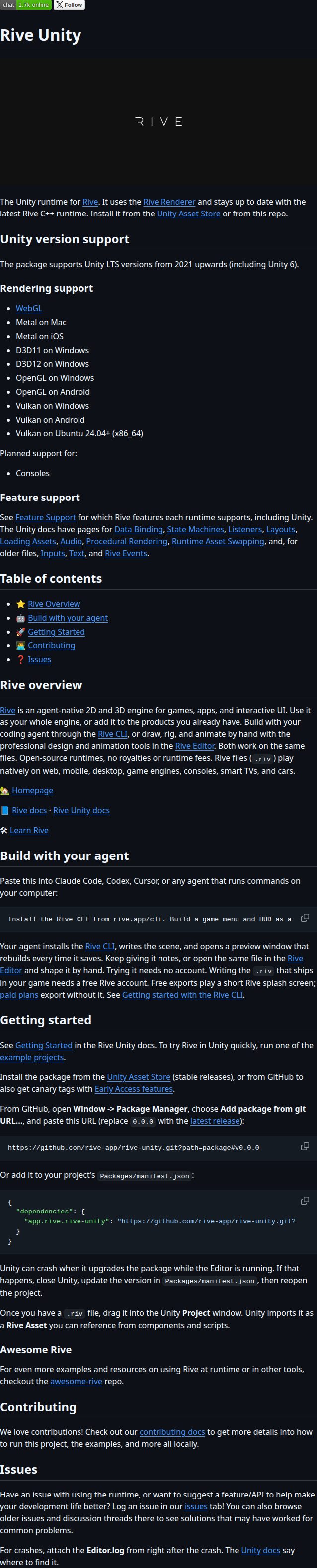 Repository screenshot
rive-app/rive-unity
Unity runtime for Rive, the agent-native 2D and 3D engine for games, apps, and interactive UI.
git clone https://github.com/rive-app/rive-unity.git
Short demos. New discoveries. Less noise in your feed.